
Sunday, October 31, 2010
A road trip with Orson
And for more thrilling vintage radio programs: http://www.escape-suspense.com/


Saturday, October 30, 2010
1st First Friday: Alumni Night

Last night was BPT's first ever First Friday: Alumni Night. A group of us alums got together and watched Leslie's lovely, funny, heartwarming play, Two Wives in India. And as if that wasn't fun enough, we hung out in the back theatre and, like a flock of vultures, hovered over lots of wine, cookies, hummus with pita crackers, and--I'm happy to say--we made a serious dent in all of
 them.
them.(In the photo: Anna Renée Pattison, John Zakrosky Jr., Kate Snodgrass, Terry Byrne)
And since I seem to be onto a bird metaphor here--I'll go further with it (like I do) and say that leaving the comforts of the cozy BPT "nest," as an alum, can be--well cold...and scary. It feels great to go back to the comforts of our theatre home, warm up with wine, catch up with old friends, meet new ones, and to have the company and kindness of one of theatre's best people ever, Kate Snodgrass. We discussed the show, theatre we've seen recently around Boston, and bitched about how hard it is to be a playwright. I got to meet the talented playwright, Leslie Harrell Dillen, who is visiting from Santa Fe, New Mexico. Really--all you alums reading--if you weren't there, you should've been! But if you missed it, don't worry! We will be holding an Alumni Night on the First Friday of EVERY show at BPT-- so mark your calendars now for December 3rd, the First Friday (also opening night) of Child's Christmas in Wales.
And if you haven't seen Two Wives in India yet, you should get your tickets right away! Don't miss this enchanting show!
Friday, October 29, 2010
The angel is in the details...
As a follow-up to my post earlier this week about Angels in America, read Ben Brantley's review of Signature Theatre's revival here.
Read others' thoughts on Angels -- including playwrights Tony Kushner, Christopher Shinn, Sarah Ruhl and Romulus Linney -- on the Signature Theatre blog, too!
Read others' thoughts on Angels -- including playwrights Tony Kushner, Christopher Shinn, Sarah Ruhl and Romulus Linney -- on the Signature Theatre blog, too!
Thursday, October 28, 2010
Fatigue or Addiction

 |
| Patrick Gabridge |
Working at BPT where every weekend is jam-packed with some new play something, I've maybe become too acclimated to the new. I used to describe new plays as the albino alligators of the theatre world. Beautiful or ugly, they are a rare find and worth lining up for. Lately I've been thinking of new play fatigue, something I have to contend with when I have my marketing hat on. New plays take more energy from the audience, don't they?
I think of myself going to the theatre; sometimes I really want to see how THAT company does THAT show. Every patron walks in with a choice of how critical to be, and what to be critical about. A new play begs to be criticized along a whole new set of criteria: the choices the playwright made, the truth inherent in the dialogue, what the actors are doing with the new material, how the director helped or hindered the playwright's strengths and weaknesses. This extra weight on the audience can even extend to whether the marketing copy representing the play they are seeing is accurate. That's a lot of critical attention for a night out.
All of that takes extra effort, and I know it wears me out. How many times a season can you take on that challenge?
Still, new play theatre going can be addictive. The magic of your first theatre experience (for me it was Peter Pan puppets in the elementary school gymnasium) can be recreated only when you don't have a clue of what you'll see when the lights go up.
New plays: do you get the fatigue or the addiction? (I hope you're addicted. We're opening Leslie Harrell Dillen's brand new Two Wives in India tonight!)
Wednesday, October 27, 2010
Plays by Noone and Bauer slated for productions in NYC
Ronan Noone’s Little Black Dress will be produced Off-Broadway in May 2011 by The Exchange. Little Black Dress received a workshop production at BPT last season; read more about the play’s intense development history here, in Ronan's program note.
Off-Off-Broadway, Monica Bauer’s Balls: The Testosterone Plays of Monica Bauer, features two short plays about men, ‘Two Men Walked Into a Bar’ and ‘Made for Each Other’. The plays will run Nov. 19-Dec. 5 at the Workshop MainStage Theatre. For more information, visit www.TheatreWithBalls.com.
Alums, share your news with us.
Monday, October 25, 2010
In case you missed it...
 |
| Ellen McLaughlin and Stephen Spinella |
...an article from yesterday's New York Times about the enduring impact of Tony Kushner's Angels in America, and the play's current revival at Signature Theatre.
I share this because Angels is a play that continues to inspire me to write. It's everything, really -- the complete theatrical package, full of big and small moments that are funny, sad, bombastic, beautiful, brutal, political, fantastical, and true. No matter how many times I read it or see it, it is always soul-stirring. When I was an undergrad, I carried around my copy of Millennium Approaches long after I finished reading it, like Linus with his blanket. (And later, watching the inimitable Kathleen Chalfant deliver that opening monologue from my seat in the second row of the Walter Kerr Theatre -- feeling like she was talking to me -- still stands as one of the most breathtaking theatrical memories of my life.)
Read the article here
Friday, October 22, 2010
Provincetown Extravaganza!
 (I'm the 2nd from the left in the top row surround by the brilliant actors, from the top left: Sonya Raye, Vincent Siders, Michelle Clunie from Showtime's Queer as Folk, Darlene Van Alstyne, Georgia Lyman. Bottom row: Lynda Sturner and Latez Crawley.)
I just rolled in from a little land I like to call gay heaven: Provincetown, or "P-Town" as it's affectionately called by those who have been too drunk there to say 3-syllable words. You may recall my shameless plug last week (you know what they say, self-promotion's a bitch, but somebody's gotta do it). So I am Anna Renée Pattison for those who missed the first self-promo. I am a recent "grad" of the BPT Playwriting Program. ("Grad" providing I pass my classes this semester.)
My play, Memorial, which takes place both in a present-day courtroom and in Memorial Medical Center in New Orleans during Hurricane Katrina, was part of BPT's Groundfloor Reading Series last spring.
Can I share a private moment with you? There is nothing more terrifying than your first reading in front of God-only-knows-who decides to sit in one of those black chairs to judge your "in-progress" work. If people are more afraid of public speaking than death, I can't imagine where a public reading would factor in. Imagine if you will, that you're in high school and write ad nauseum about the boy or girl you're obsessed with (including the graphic stuff you can't say out loud) in your nerdy floral print journal your mom bought you.
 Your best friend steals it and organizes a school assembly where they get the drama department to act out every last word from your daisy-covered journal. Said object of obsession is sitting in the front row. The assembly lasts 6 hours or just feels like it. Then there's a question and answer session following, where you're tied to chair onstage. I think if you can imagine what that's like, you may have an idea about how vulnerable and horrifying the first reading of your play is. So why do I do it? I guess I'm sort of a masochist...but I also do it for the exciting parts that follow. Like, after that excruciating school assembly, that chick or dude you think you're going to love forever shockingly approaches you and gives you a kiss. Was it worth it? Hell yes. I was lucky enough to get proverbially kissed--we haven't hit a home run yet if you know what I mean, but things are looking good.
Memorial was read again last week at the Art House in P-Town, but this time was a totally different experience. For one thing, I had revised, revised, cut 30 pages, revised, cut a character, changed a character's gender and sexual orientation, revised more, edited more, and revised. Oh yeah, and I revised the play. But it was also different because we had three and a half days of rehearsal (instead of 3 hours), the director knew the play inside and out, and we had lights, sound, costumes, and props thrown in the mix. Also, the theatre had a full bar inside so there's a lot I probably just don't remember. Lynn d'Angona was amazing to collaborate with--which to me means I learned a lot from her, she was open to my ideas, and she was a brilliant diplomat. The actors rocked my world (see photo above) in ways you can't even imagine, which sounds kind of dirty but, you know. It was P-Town during Women's Week. What are you gonna do?
I was also lucky enough to work with an incredibly talented sound designer, Darby Smotherman, who is in her final year of the MFA Sound Design program at BU. It was an amazing experience and a great opportunity. Lynn d'Angona and I are now in the process of organizing meetings to get a full production in Boston. So, with any luck, that "girl I've been writing about in my journal" will want to commit to a steamy "relationship" with a 6-week minimum run. But I have to say, I'm enjoying the ride so far, and I've been lucky enough to work with some remarkable people along the way. I'm excited for what's next on the road ahead--and that's one too many metaphors so I'm out and I'll see you next Friday. Peace.
Thursday, October 21, 2010
The First Year Out
Anyone who goes through an intensive Creative Writing workshop knows the feeling of directionlessness after the final class. How will I keep writing? Do I have to make a living, too? I asked Walt McGough (who received his diploma three days ago) what the first year out has been for him.
Walt: I would wager that the only near-universal feeling for playwrights leaving a writing program is one of complete, abject panic. Questions start swarming as soon as you step outside of BPT's walls (or at least they did for me): "What do I do now?" "Should I start something new, or keep editing?" "How am I supposed to write plays without a weekly deadline imposed on me?" In short: "How do I stay inspired?"

BU's program is a pressure cooker of good writing and great ideas, where you spend a large portion of your week sitting in a room with smart people and talking about making the art that you love. That can really spoil a guy, which made it easy to feel adrift once I was out on my own. And, yeah. A bit of panic ensued. But it got better! So much better.
And the way it got better, weirdly enough, was not writing. Not immediately, at least. Cast out into a strange and frightening world, I found that I couldn't even start thinking about writing without first establishing what I was writing for. I mean, The Art, obviously, I guess, but I needed something more concrete to un-block myself. So I researched and found new reasons. I started by just asking people I knew if they knew any festivals/contests/workshop opportunities I should be trying for, or any theatres around town I should be paying attention to. Then I went to the Dramatists Guild's reference site and pulled a few things that looked interesting. Then I started looking around Boston, and seeing what companies were in the neighborhood that I should be paying attention to. Then I laid that info all that out, put it in some kind of order, and soon I had a big honking spreadsheet full of submission information, selection criteria, and most importantly, deadlines. Beautiful, beautiful deadlines. Spaced regularly enough to keep me working. Some of the submissions involve re-tooling stuff I have left over from class, but the ones that I like most are the ones that force me to write new stuff. Because doing that reminds me that I can write new stuff, even when I'm not in school, and that's an exciting and necessary reminder. I still have good days and bad days, and it's not like I'm churning out manuscripts by the dozen every morning, but I'm still moving forward, and plugging away.
And in the meantime, I'm just recently figuring out the last piece of the puzzle: support networks. Turns out, all those smart people I got to talk to every week at BU? They didn't just disappear. They're still around. Most of them, anyway, and they're still all excited about theatre and it's still fun to talk to them about it and even share work sometimes. I also lucked into a job with SpeakEasy Stage Company, which means that I get to spend my day working in the business side of things, and get a better feel for the Boston theatre landscape. And then, also, I got engaged right after school ended, and that's been pretty fantastic all the way through.
So, yes. Blind, abject panic. But then it gets better. And it keeps getting better. And with any luck, it will continue to keep getting better. Just as long as I keep writing, and building, and continuing all of the great grand enjoyable work that I got started under the watchful eye of dear ol' BPT.
Wednesday, October 20, 2010
Mad for Mad Men...and for playwrights who write for TV
I am funny when it comes to television. And I mean funny-weird and not funny-ha-ha, because I tend to commit to a single show at a time, and go about watching it with gusto. This means I’ll watch a weekend marathon of a show I’ve never seen before and become completely obsessed; or I’ll decide to focus on one show, never missing an episode week after week. Some of the shows I’ve watched this way over the years: China Beach, Thirtysomething, My So-Called Life, The West Wing, Big Love, South Park (yeah, I know that one doesn’t quite fit in, but I have to admit I’ve always wanted to confess to the Vanity Fair Proust Questionnaire that Eric Cartman is my favorite hero of fiction. But I digress.).
And so this brings me to the most recent object of my affection: Mad Men. Why do I love it so? First of all, it is set in what is arguably the most fascinating decade of the last century from a social and political standpoint, the 1960s. Second, the wardrobe (and hair – mustn’t forget the hair) is simply fantastic. But the real reason I didn’t miss an episode this season lies beyond the show’s finely-coiffed historical framework: the writing. Television being television, the trajectory of the storylines is different of course, but the show has all the things we identify as being essential to great theatre: complex characters, rich subtext, smart dialogue. These are believable people in real, even mundane – and yet still incredibly interesting – situations and the stakes are high. It’s the total package.
Here's something I've never done before, with any show: Every Sunday night during the season, AMC runs a new episode and then repeats the episode the following hour as an encore. About six weeks ago, I watched the new episode (the one where Don and Peggy stay at the office all night – titled “The Suitcase,” for anyone keeping score) AND the encore back-to-back. I literally didn’t move. Truly a “do that again!” moment. This week's season four finale? Flawless. I already can't wait to see what 1965 holds for my friends at Sterling Cooper Draper Pryce...
[I also confess to having a strange crush on Don Draper, but I’ll save that for another post. Or not.]
 |
| Playwright Keith Huff, also a writer for Mad Men |
What do these – and many, many other – shows have in common? Many are/were helmed by, or rely largely on the talents of playwrights – Aaron Sorkin, Melanie Marnich, Gina Gionfriddo…and that’s just to name a few. Earlier this year WSJ ran an article on just this very thing. I think it’s exciting to see more and more playwrights make their way to television. It means I get to enjoy their work – in my pajamas. For free. (Or, at least, for the price of cable.) It means these talented people can simultaneously feed their families, my hunger for their work, and their own desire to write. It’s also an opportunity to study how each playwright adapts his or her own voice (or not) to a medium other than the stage. And, as a playwright, it’s another chance to root for what feels like the home team: “Ooooh look – Theresa Rebeck wrote this episode of Law & Order. Sweet!”
And so this brings me to the most recent object of my affection: Mad Men. Why do I love it so? First of all, it is set in what is arguably the most fascinating decade of the last century from a social and political standpoint, the 1960s. Second, the wardrobe (and hair – mustn’t forget the hair) is simply fantastic. But the real reason I didn’t miss an episode this season lies beyond the show’s finely-coiffed historical framework: the writing. Television being television, the trajectory of the storylines is different of course, but the show has all the things we identify as being essential to great theatre: complex characters, rich subtext, smart dialogue. These are believable people in real, even mundane – and yet still incredibly interesting – situations and the stakes are high. It’s the total package.
Here's something I've never done before, with any show: Every Sunday night during the season, AMC runs a new episode and then repeats the episode the following hour as an encore. About six weeks ago, I watched the new episode (the one where Don and Peggy stay at the office all night – titled “The Suitcase,” for anyone keeping score) AND the encore back-to-back. I literally didn’t move. Truly a “do that again!” moment. This week's season four finale? Flawless. I already can't wait to see what 1965 holds for my friends at Sterling Cooper Draper Pryce...
[I also confess to having a strange crush on Don Draper, but I’ll save that for another post. Or not.]
Tuesday, October 19, 2010
Leather Jacket
So Adrien bought a jacket at Goodwill.
ADRIEN: How fucking sweet is this? Fourteen bucks!
JAKE: What?! That was my jacket! I was going to buy a jacket today!
ADRIEN: What? Not this one, this jacket wouldn’t fit you.
JAKE: Yes it would. Let me try it on.
It fits.
ADRIEN: Okay.
JAKE: Damnit!
MIKE: It fits you both remarkably well.
ASHLEY: That’s a nice jacket, what brand name?
ADRIEN: (reads) Liz Claiborne.
Office erupts.
Adrien learns that he purchased a woman’s jacket.
 |
| Adrien in his beautiful new jacket and the envious Jake |
The End.
-- Mike
Monday, October 18, 2010
Why lasagna?
 |
| Mmmmm... Kate's lasagna! |
Kate
Friday, October 15, 2010
Q&A with Jonathon Myers
We recently shared the news that Snovi, a short film co-written by Jonathon was screened at the Sarajevo Film Festival last summer. As a follow-up, we thought it would be fun for Jonathon to expand on this unique experience.
 |
| The writer hard at work |
To answer this question and the next is really to describe the process from my perspective while giving due credit to the leader of that process. All of the connections in this project are through another BU alumnus: the director, Reshad Kulenovic. As the director (and essentially the director of production) he has always been the center of the entire project. Reshad was in the MFA program in Film Production and I was taking screenwriting courses with Professor John Bernstein after my MFA in Playwriting. Reshad and I became friends who participated in the writer/director cliché of having deep philosophical conversations over coffee at the Espresso Royale near BU Central. It was a good combination; his focus on imagery and cinematic qualities connected with my focus on character, dialogue and story. My play Little Red Hen was an ACTF regional finalist that came out of workshop days with the CFA. When it was produced at BPT by the Useless Theatre Company in January of 2008, Reshad saw it and liked it. John Bernstein suggested to both of us that we start collaborating as a writer/director combo.
We decided to enter a competitive event that challenged us to fully produce a 5 minute digital movie in one week. Unfortunately, our schedules were tight and despite a ready script and some pre-production we need to shoot in two locations and fully edit a cut in less than three days. I had to take up some Director of Photography duties at times and we had to work together seamlessly. At one point -- about 50 hours into the process -- when together we had a total of around 2-3 hours of sleep, we questioned the project and considered giving up. Thankfully, we persevered and completed the project on time. The result had some issues, as one would expect with that schedule. The sound in particular was rough, and ultimately that final product feels a little like a student film with better than average visual execution. But I think we gained some respect for each others’ work ethic after that. We vowed to work on another project again in the future.
Due to these experiences, I appreciated Reshad’s directing and he appreciated my writing. That mutual admiration kept us connected. I was always looking to contribute my writing to his projects and like a good director he was always looking for the good stories and writing. Over the next year Reshad and I worked on a few different stories and I wrote multiple screenplay drafts and revisions for these shorts, ranging from incomplete drafts of a few pages to grossly overwritten drafts at around 40-45 pages. Overall, I easily put out several hundred pages of writing and rewriting. (My experiences of rewriting at BPT served me well.) John Bernstein was mentoring, so he was reading the drafts and providing feedback about what wasn’t working and what needed to be rewritten.
Thursday, October 14, 2010
4 Questions with Melinda Lopez
I asked Melinda a few questions about her experience as a teacher of playwriting. Melinda teaches in Boston University's MFA in Playwriting offered at Boston Playwrights' Theatre.
Can you give an example of something you experienced as a student in workshop that you try to avoid in your classrooms now? Are you successful?
 I once told a classmate that his play would be better if "someone died." As a result now, I rarely speak at all in class. Actually, no-- but I try to focus on the world the writer has created, and how her choices are successful or unsuccessful in that world.
What playwriting exercise do you assign that often bears the most fruit?
Only write what your mother would enjoy. Better still, only write plays that win major national prizes. That way, you'll never be embarrassed or afraid.
What play / playwright do you most often recommend new playwrights read? Why?
I recommend a lot of Mamet's plays because in form and action they are so tight. Adam Bok. Jose Rivera. Theresa Rebeck, always. Of course, Euripides. Rajiv Joseph is a new favorite.
What is the most difficult lesson to teach a playwright?
What matters most is what you think. Because someone else will always think it's better "if someone died."
Can you give an example of something you experienced as a student in workshop that you try to avoid in your classrooms now? Are you successful?
What playwriting exercise do you assign that often bears the most fruit?
Only write what your mother would enjoy. Better still, only write plays that win major national prizes. That way, you'll never be embarrassed or afraid.
What play / playwright do you most often recommend new playwrights read? Why?
I recommend a lot of Mamet's plays because in form and action they are so tight. Adam Bok. Jose Rivera. Theresa Rebeck, always. Of course, Euripides. Rajiv Joseph is a new favorite.
What is the most difficult lesson to teach a playwright?
What matters most is what you think. Because someone else will always think it's better "if someone died."
Tuesday, October 12, 2010
Ugly Orange Chairs
Why does Boston Playwrights’ Theatre have so many ugly orange chairs?
 One day Jake and I got a call from someone from somewhere on campus about hundreds of free chairs available from a hotel Boston University was renovating. This was our opportunity to finally have a dozen or so ugly orange chairs at the theatre, so we hustled off to a warehouse just a few blocks west of BPT.
Not only was a flatbed truck filled with said chairs but the warehouse also seemed to be packed. A gentleman whom I can only assume was the Ugly Orange Chair Shift Supervisor asked how many we wanted—Jake said seven...I said fourteen.
A few days later, in the pouring rain mind you, the chairs were delivered, and Jake and I spent the better part of the afternoon drying them and trying to cram every corner of the theatre with OUR ugly orange chairs.
And so goes the origin story for Boston Playwrights’ Theatre’s ugly orange chairs.
-- Mike
-- Mike
Monday, October 11, 2010
Friday, October 8, 2010
A New Play to Benefit Breast Cancer Awareness Month

Every year around this time in Provincetown, women come together to celebrate Women's Week and Breast Cancer Awareness Month. For the past 3 years, filmmaker Lynn D'Angona has organized a fundraiser event during Women's Week, promoting Women's Health Services as part of the charity she started, Provincetown Cares. The event includes a female driven play reading and a live auction, all for the sake of--as Michelle Clunie, star of Showtime's Queer as Folk puts it-- "kicking the shit out of breast cancer." Michelle Clunie has starred in each of these play readings, and will be acting again in the reading this year of Anna Renée Pattison's new play, Memorial, inspired by actual events that took place at Memorial Medical Center during Hurricane Katrina.
In previous years, the fabulous Maureen Keiller has starred in Provincetown Cares' staged readings, and recounts a memorable event at the auction last year--convincing Michelle Clunie and Georgia Lyman to lock lips: "The crowd went nuts!" Maureen recalls. And of course, it was for charity after all...

(Maureen Keiller, Michelle Clunie, Georgia Lyman; photo courtesy of Maureen Keiller)
The playwright of this year's Provincetown Cares event, Anna Renée Pattison, was part of the MFA Playwriting Program at BPT this past year, and developed Memorial primarily in a workshop taken with Melinda Lopez. An earlier draft of the play was presented last April as part of the Ground Floor Reading Series at BPT.You can catch this year's Provincetown Cares event: Memorial, and an auction (where anything is possible) at the ArtHouse in Provincetown- Saturday, October 16th at 2pm and 6pm. Tickets are available at www.provincetowncares.com. The proceeds will benefit both local and national organizations committed to research, education and treatment services for women in our communities.
Alums, share your news with us.
Thursday, October 7, 2010
3 Questions with Kate (on the MFA at BPT)
 Less public than our productions but no less harrowing to our playwrights are our weekly workshops -- our classes taught (often on the set of our current shows) by playwrights Kate Snodgrass, Richard Schotter, Melinda Lopez and Ronan Noone. And if you didn't know it: Boston Playwrights' Theatre is Boston University's Playwriting MFA program. I asked Kate Snodgrass a couple questions about her experience as a teacher of playwriting.
 Jake: Can you give an example of something you experienced as a student in workshop that you try to avoid in your classrooms now? Are you successful?
Kate: In a fiction workshop I was attending, the teacher laughed at one of the student's stories. I don't laugh at any serious stab at playwriting--it's hard enough to write as it is. And yes, I'm successful because I remember that student's face.
J: What play or playwright do you most often recommend new playwrights read? Why?
K: We're all different writers who gravitate to different rhythms, tones, worlds, and there's room for everyone in the theatre. I wait until I understand what might encourage a particular student, and then I suggest a specific play or playwright s/he might gravitate toward. There are playwrights with whom I think we ALL must be familiar, but...that's a different question. (Okay. Shakespeare, Buchner, Chekhov, O'Neill, Wilder, Beckett, Pinter, Churchill, Stoppard, LePage. And some others.)
J: What is the most difficult lesson to teach a playwright?
10/10/10
Regardless of Jake's reluctance to accept that the entire month of October is pretty interesting (because every day is surrounded by the number 10) I've come up with a great idea that I hope you'll enjoy. This month is so remarkable in fact that all tickets this Sunday (10/10/10!) will be...you guessed it, $10!
This only happens 12 times every 1000 years!
You're welcome--no thanks to Jake.
You can get your "very special" tickets on our "very special" website and use the promotional code: 101010
-- Mike
This only happens 12 times every 1000 years!
You're welcome--no thanks to Jake.
You can get your "very special" tickets on our "very special" website and use the promotional code: 101010
-- Mike
Wednesday, October 6, 2010
Lazarus rules SLAMBoston and has lots going on...
 Alumna Ginger Lazarus has a lot cooking this month:
 Monday night’s SLAMBoston winner, The Double Life of Clem Midnight, is featured again tonight, in this festival of short plays in slam format. Don and Stacy have a special bond with their cat Clem...until it turns out they aren't the only people in Clem's life. Tonight, October 6, at the Factory Theater. 7:30 p.m. Buy tickets here.
Mary, a short film based on Ginger’s play of the same name, has been selected for the New Hampshire Film Festival in Portsmouth, October 14-17 (showtimes TBD). It also played at the Connecticut Film Festival back in May. View the film here.
Next on Ginger's calendar is a collaboration with fellow alum Jess Martin. Watch this space for further details as this ambitious project evolves...
Alums, share your news with us.
Tuesday, October 5, 2010
Closed set
I was talking with someone the other day about odd things I’ve seen audiences do when entering a theatre space.
Several years ago we had a show where the audience had to walk across the stage to get to their seats. The set had a few props preset including a table with food, which the audience proceeded to eat when they entered the space. Now, not all the audience members ate the food, but a few tried before they were asked to take their seats and to leave the food alone.
Maybe we just had ravenous audience members.
God help us if we ever have a toilet on stage.
--Mike
--Mike

Monday, October 4, 2010
Laundry
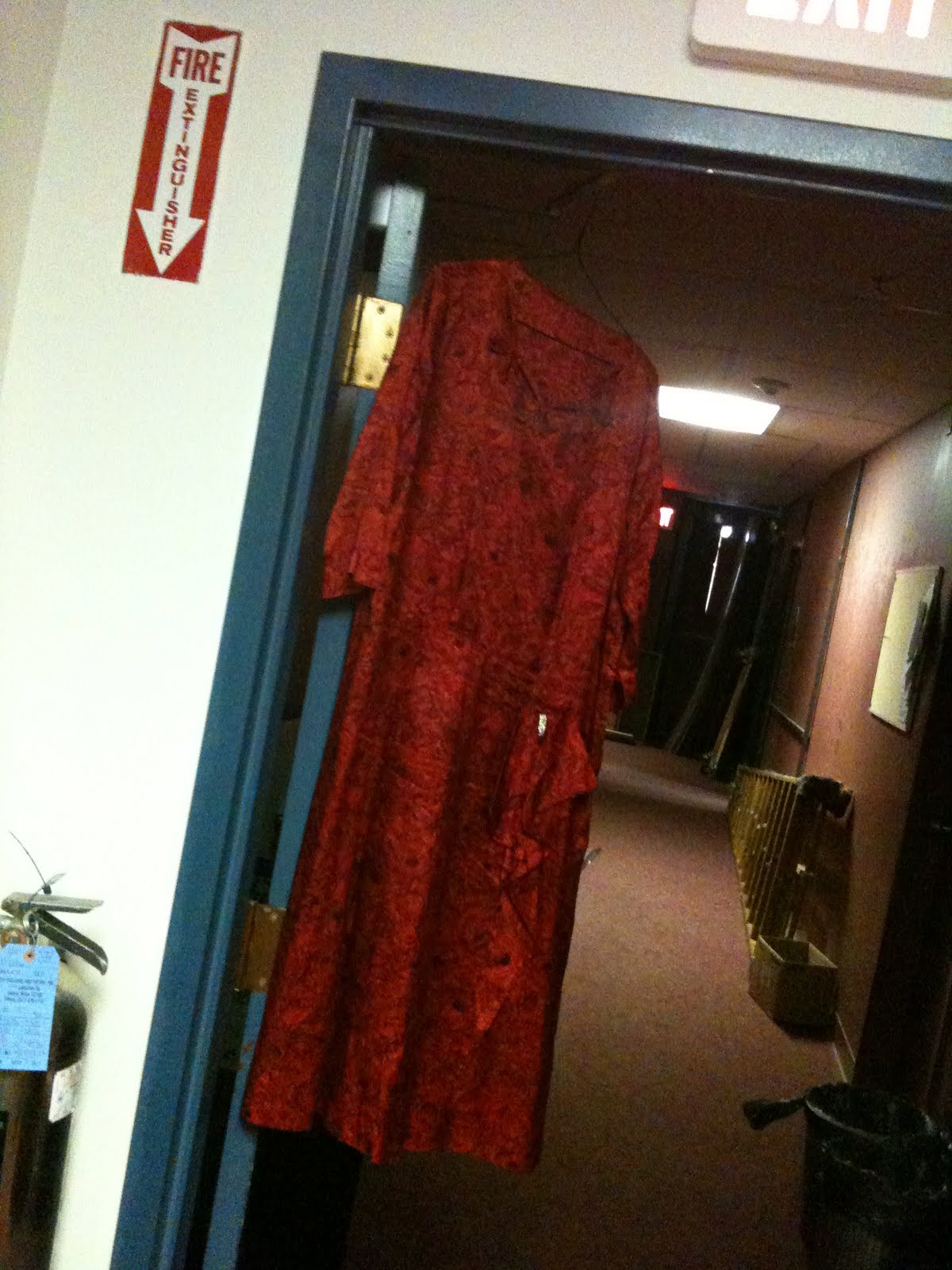
Laundry. Think about it. It has got to be done, whether we're in the theatre or not, and I have to say I've learned more about polyester, cotton, and silk from picking up the slack in theatre laundry duties than my mother ever taught me.
How do you get fake blood out of a shirt? I can tell you. Better yet, I can SHOW you. Answer: You spray the blood stain with Oxy-Clean, let it stand, then you wash that off with cold water and soak the shirt in bleach. If all else fails, you buy another shirt.
What do you do when a dress has to be dry cleaned, and you have 8 hours to do it? Answer: You don't dry clean it (you can't--no dry cleaning shop will get it back to you on time), you spray it with Dryel. If that fails, you spray it with vodka and hope for the best. (Vodka is good for so many things in the theatre.)
What do you do when the theatre has no washer/dryer in which to do the laundry on a nightly basis during a performance? (This happens to be the case at BPT.) Answer: First, you try your best to get someone else to do it. Believe me, there are many excuses for not doing the laundry--"Sorry, I don't live near a laundromat"; "Sorry, I'm not coming in tomorrow"; "Sorry, my dog ate my washer/dryer." If all else fails, you take the laundry home overnight and bring it back to the next performance. Why? Because you love the actors! At the very least they deserve a clean shirt to wear tomorrow. I love this 5Down, 1Across cast and crew, so when they need my expert laundry skills, I'm there for them. Yes, I'm an Artistic Director, and yes, I can wash clothes, and yes, I'm good at it.
If you hate the thought of an Artistic Director washing out the actors' dirty laundry, get over it! (There are no small jobs, only small artistic directors.) Or you can buy us a stackable washer/dryer. We'll name them after you. We'll put up a plaque. "Donated by Fill-In-Your-Name, a kind and generous person who couldn't stand the thought of Kate doing laundry." Or something like that.
In either case, I'm happy. In some small way, I've helped. And the world is better.
Kate
Friday, October 1, 2010
"Ahhh, yeah, sometimes this theater thing turns into a bit of a blood sport, doesn’t it?"

Boston Globe preview article for Five Down, One Across by Michael Towers. Read the entire article here.
Subscribe to:
Posts (Atom)